
When Will the “Forget Not in Ju” Boulder Be Ground Down?
Kinmen · A rock that carves “I’ll leave the moment I win — don’t treat this place as home” into the ridge of your own mountain.

C.Y.Lu | Island Vantage · Case File IS301 ·
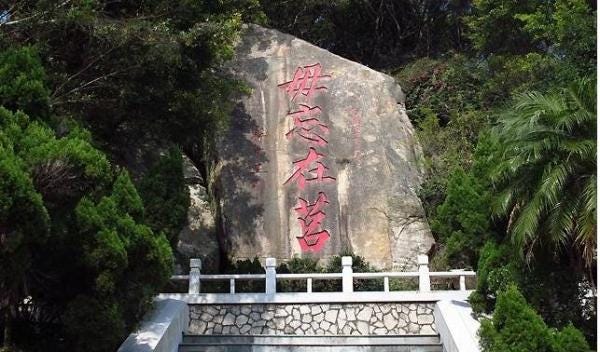
When the occupier ages out, what stays is not memory. It is granite.
I argued something close to a law of geography: Kinmen is never the protagonist, only the last stage a protagonist reaches after defeat; and the people who made Kinmen need protecting, and the people who protected it, are the same people. That essay was about feeling — how gratitude, grown without a control group, hardens into sincere belief.
This essay is about stone. Because feeling dies with people; stone does not. When the occupiers age, die, and dilute into history, the most durable thing they leave on this island is not memory. It is granite.
The boulder atop Taiwu Mountain — 毋忘在莒, “Forget Not [the days] in Ju” — was inscribed by Chiang Kai-shek in 1952. In 1953 the Kinmen stonemasons Zhang Qingfa and his son Zhang Zaixing led eight craftsmen, raised bamboo scaffolding, slept in a cave, and spent four months carving it. The fee was three thousand dollars. That is the most honest line in the boulder’s ledger: the hands that carved it were Kinmenese, and what those hands carved was not what a Kinmenese would have chosen to write.
A sentence about defeat, disguised as a sentence about resolve.
Those four characters are a sentence about defeat, disguised as a sentence about resolve.
The allusion runs two layers deep. The shallow layer is Tian Dan’s restoration: in the Warring States period, the state of Qi was overrun by Yan and reduced to two lone cities, Ju and Jimo; Tian Dan counterattacked from Jimo and, years later, recovered the realm. The deeper, older layer is Duke Huan of Qi — exiled in Ju before he took the throne, later returning to become hegemon, reminded by his minister Bao Shuya over wine to “forget not the flight to Ju,” the humiliation of living on someone else’s land. Chiang wanted both layers stacked: remember the shame of being reduced to two islands, remember that this is only a place of exile, and then strike back like Tian Dan.
Here is the problem. In that allusion — who is Kinmen?
Kinmen is not Tian Dan. Kinmen is Ju. Ju is not the hero of the counterattack. Ju is the city that shelters the defeated, the place a fallen ruler borrows, the “me” in “my lord, do not forget that you once hid here in disgrace.” To carve 毋忘在莒 onto Taiwu Mountain is to chisel a stranger’s vow into the islanders’ own summit: this is not home, this is a waystation; when I win, I leave.
It is a rock that carves “I’ll leave the moment I win — don’t treat this place as home” into the ridge of your own house. And Kinmenese masons cut it in, stroke by stroke.
The political economy of carving a promise into granite.
Every slogan is a forecast. 毋忘在莒 forecast the counterattack, the restoration, the ending Tian Dan got. That forecast expired — seventy years on, the counterattack never came, the ending never came.
A forecast that expires on paper gets thrown away; a forecast that expires in a newspaper is buried by tomorrow’s edition. But a forecast that expires in granite has no mechanism to retire it. That is the political economy of carving a promise into stone: the stone is a commitment device, built to bind the future to a present resolve. The one who swore it bet that stone outlasts second thoughts — and he was right. The regime that made the vow is long gone, the men who would have redeemed it are long gone, but the cost of maintaining the boulder, walking around it, being defined by it, falls on people who never placed the bet. It is a textbook principal-agent problem: the party who signed has left, and the cost of performance is left to those who never signed.
So why not grind it off?
Because grinding it off is expensive, and leaving it is cheap. The physical nature of granite happens to subsidize one particular memory. Natural weathering runs on geological time — effectively eternal on a human scale; deliberate removal requires someone to fund it, to spend the political will, and then to absorb the charge of “destroying a historic site.” So “leave it” is forever the path of least resistance — not because Kinmenese keep agreeing with what the boulder says, but because the cost of disagreeing far exceeds the cost of acquiescing.
The same logic explains the bronze statues, Zhongzheng Road, Jingguo Road, scattered across the island. Renaming a street means amending the land registry, the maps, the door plates, the contracts, every document that ever wrote the address; the switching cost lands on the people who live on it, while the commemorative benefit — if any remains — belongs to no one. So the names stay and the statues stay, on inertia, not endorsement. Mistaking inertia for public will is the cheapest inheritance authoritarianism leaves to democracy.
And one layer deeper: the fact of occupation has no equivalent monument. There is no boulder of equal size carved “forget not the civilian land seized in 1949.” The narrative of protection has granite; the narrative of occupation has only the spoken testimony of the elderly, and testimony dies with its witnesses. The landscape itself is an information asymmetry — one side holds a permanent medium, the other only a mortal memory. Given enough time, the side that remains looks like the only truth.
It has already been ground down — not by a chisel, but by tourism.
Here is where the other side deserves its say, because the other side is not weak.
First, the gratitude was real, and the defense was real; that was IS40’s conclusion, and I do not retract it. Second, seventy years on, the boulder is no longer only Chiang’s boulder — it is the summit Kinmenese have climbed countless times, the backdrop of graduation-trip photos, the landmark of “we in Kinmen have this.” Meaning changes hands. The person who calls it an authoritarian totem and the person who treats it as a coordinate of homesickness may be the same Kinmenese. Third, grinding off a stone is itself a kind of erasure; using today’s fastidiousness to scrape away yesterday’s traces is not obviously more honest than leaving them. Preservation is not endorsement.
All these rebuttals hold. But they have, in fact, already answered the title’s question — only the answer is not the one you expected.
When will the “Forget Not in Ju” boulder be ground down?
The answer is: it already has been. Not by a chisel — by tourism. When a blood-oath of reconquest becomes a duty-free-shop-grade landmark where visitors throw up a peace sign, its meaning as a vow has long since been ground to powder. The market found the most elegant way to dispose of an expired forecast — not by refuting it, but by turning it into a souvenir and selling it. The stone still stands; the vow is hollow. The weathering of meaning runs far faster than the weathering of granite.
The question is not when it disappears, but when Kinmen can carve its own line beside it.
So the real question was never when the stone disappears. Granite will outlast every one of us; no argument there. The real question is: when will Kinmen have the capacity to carve, beside it, a line of its own?
Not to scrape 毋忘在莒 away, but to end its monopoly. To give the page of occupation a medium of equal weight and equal endurance; to stop the island’s memory from being defined solely by the vow of a fallen guest. What this takes is not dynamite. It is the thing IS40 found missing and never refilled — the civic capacity, stripped away by nearly four decades of military administration, to author one’s own record. A society never once permitted to raise its own monument does not suddenly know what to carve for itself.
When will that boulder be smashed and ground flat? Geology says: a very, very long time from now. Political economy says: the first time the cost of keeping it rises above the cost of telling the truth — and that day will turn not on grinding it down, but on Kinmenese finally being able to carve, right beside it, a sentence no one paid them to carve.
Chiang’s characters are still up on the summit. They are a vow demanding that a place of refuge forever remember its guest will leave, and they are a monument to a society that has not yet learned to speak for itself. Both of these are true at once.