

C.Y. LU | July 10, 2025
1. Introduction
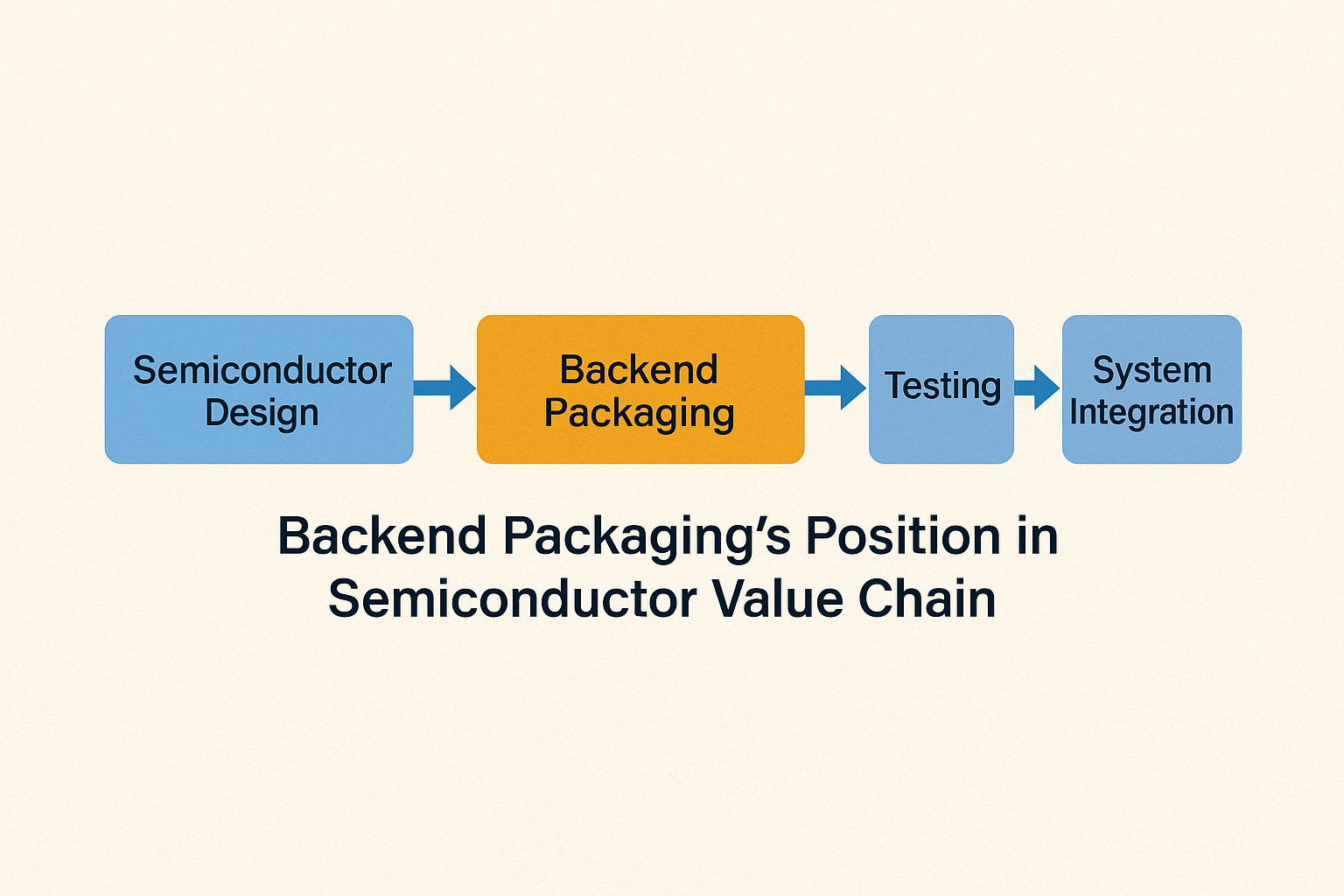
In the semiconductor industry, backend packaging has evolved from a passive post-processing step to a strategic enabler of system performance, miniaturization, and heterogeneous integration. As Moore's Law slows and integration complexity rises, backend packaging now plays a more critical role than ever in driving system-level innovation.
This document explores how packaging is shifting within the semiconductor value chain and examines its strategic implications across technology, manufacturing, and business models.
2. Problem Statement
Traditional packaging processes—such as wafer bumping, dicing, die attach, wire bonding, and molding—have long been considered labor-intensive and low-margin. However, the rise of advanced computing (AI, HPC), edge devices, and multi-die architectures (e.g., 2.5D/3D ICs, chiplets) is pushing packaging to deliver:
Higher I/O density
Better thermal performance
Shorter signal paths
Support for heterogeneous integration
Key challenges include:
Integration of dies from multiple nodes and foundries
Yield loss due to fine-pitch interconnects and ultra-thin dies
High capital intensity of advanced packaging equipment
Insufficient design and simulation capabilities among traditional OSATs
These gaps put traditional Outsourced Semiconductor Assembly and Test (OSAT) providers at risk of being bypassed by foundries and system companies offering in-house packaging.
3. Current State Assessment
Leading OSATs (e.g., ASE, Amkor, JCET) are transitioning to offer higher-value packaging solutions, including:
Fan-Out Wafer-Level Packaging (FOWLP)
2.5D/3D integration with TSVs
System-in-Package (SiP) modules
Integrated thermal and EMI solutions
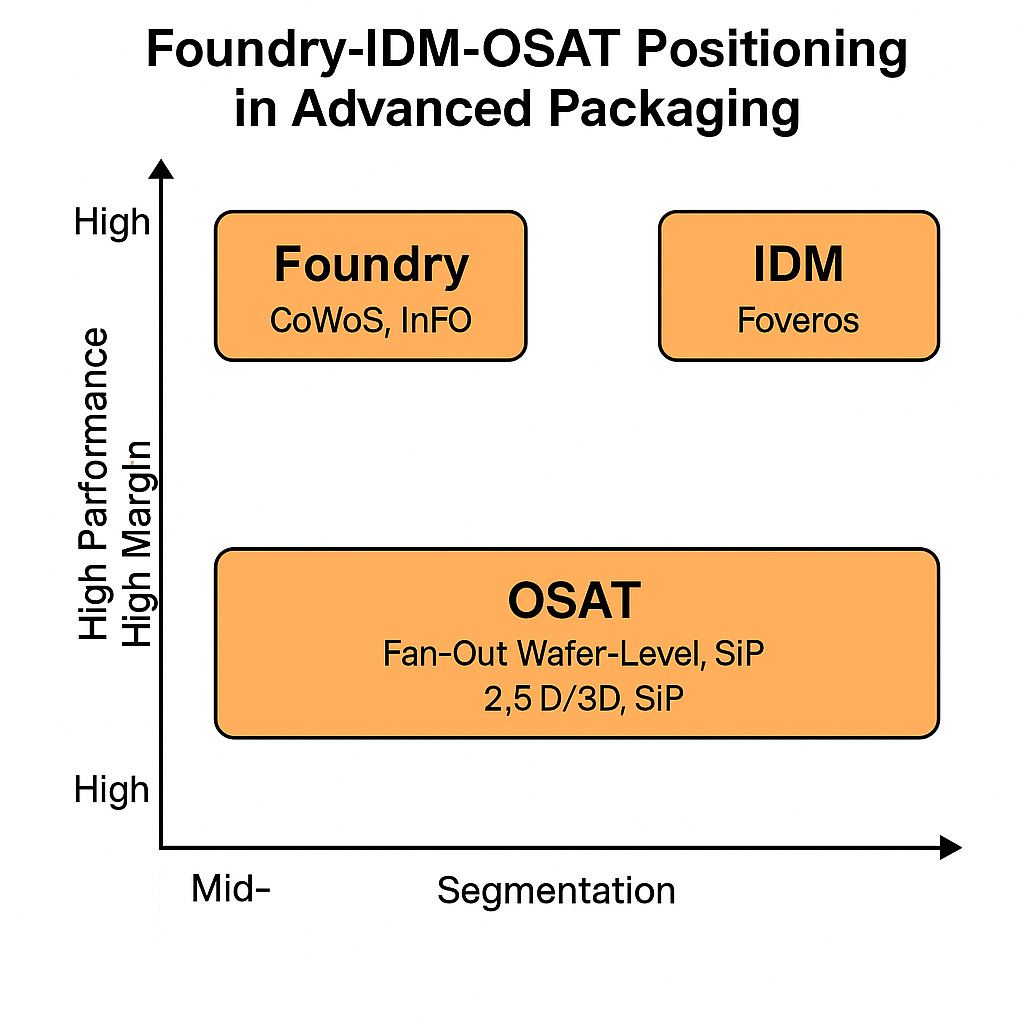
Meanwhile, foundries like TSMC (CoWoS, InFO) and IDMs like Intel (Foveros) are integrating packaging into their offerings, leading to a clear bifurcation:
High-performance, high-margin packaging → Captured by foundries and IDMs
High-volume, mid-range packaging → Remains with OSATs
Emerging markets (e.g., automotive, AR/VR, medical AIoT) offer growth potential but demand greater design collaboration, substrate innovation, and thermal reliability from packaging providers.
4. Proposed Solutions
To avoid marginalization and capitalize on next-generation system integration, backend packaging firms should pursue the following strategies:
Develop heterogeneous integration platforms: Invest in FOCoS, chiplet assembly, and hybrid bonding.
Strengthen design and simulation support: Build co-design platforms with system designers and foundries.
Partner with materials and substrate innovators: Solve bottlenecks in high-density RDL, glass cores, and thermal interface materials.
Integrate with ecosystem partners: Establish design hubs near fabless clusters (e.g., Hsinchu, Silicon Valley) for faster iteration.
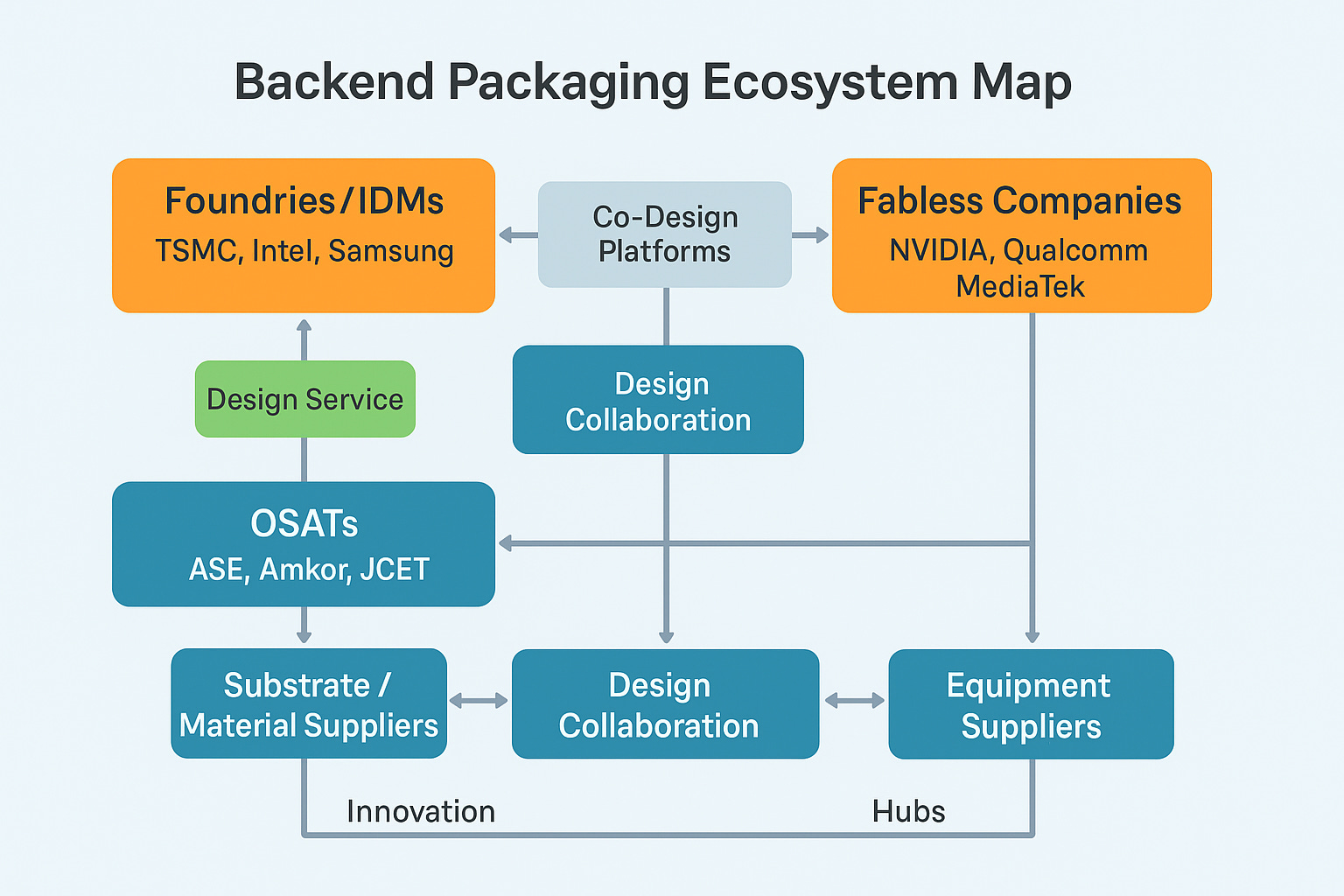
This figure outlines the ecosystem of backend packaging, mapping key players, roles, and design collaboration workflows:
🔹 Key ecosystem players:
Category
Examples
Description
Foundries / IDMs
TSMC, Intel, Samsung
Provide wafer fabrication and advanced packaging with platform leadership
Fabless Companies
NVIDIA, Qualcomm, MediaTek
Chip/system architects; rely on external packaging partners
OSATs
ASE, Amkor, JCET
Volume packaging; transitioning to system integration and design services
Substrate / Materials
Advanced substrate and material providers
RDL, glass core, TIM suppliers enabling innovation
Equipment Suppliers
Lithography, bonding, laser drilling
Enable high-density, advanced packaging capabilities
Co-Design / Design Services
Design & simulation platforms
Support system-level design across chip and package
🔁 Interaction Flow:
Fabless ↔ Co-Design Platforms ↔ Foundry/IDM → Collaborative architecture and packaging design
Fabless ↔ OSATs → Specification delivery and packaging integration (e.g., SoC + SiP)
OSATs ↔ Material / Equipment Suppliers → Joint development of processes and tools
Design Services → Connect upward to foundries and IDMs → Signaling OSATs' strategic upgrade toward design participation
📌 Key Observations:
Design collaboration is the core differentiator in packaging value creation
Innovation is decentralized—materials and equipment vendors are becoming crucial enablers
OSATs must transform into integrators and co-developers, not just manufacturing vendors
5. Key Benefits
Benefit Type
Description
System Performance
Shorter interconnects enable higher signal integrity, bandwidth, and lower power
Business Model Upgrade
Transition from labor-based to design- and simulation-driven value creation
ESG Compliance
Advanced packaging enables better thermal control and lower carbon footprint
Regional Resilience
Proximity to customers improves co-design and reduces supply risk
6. Conclusion
Backend packaging is no longer the final step in manufacturing—it is the launchpad of system innovation. As technology and business models converge, packaging must move upstream and actively participate in system design. The future belongs to those who invest in integration, simulation, and cross-domain partnerships.
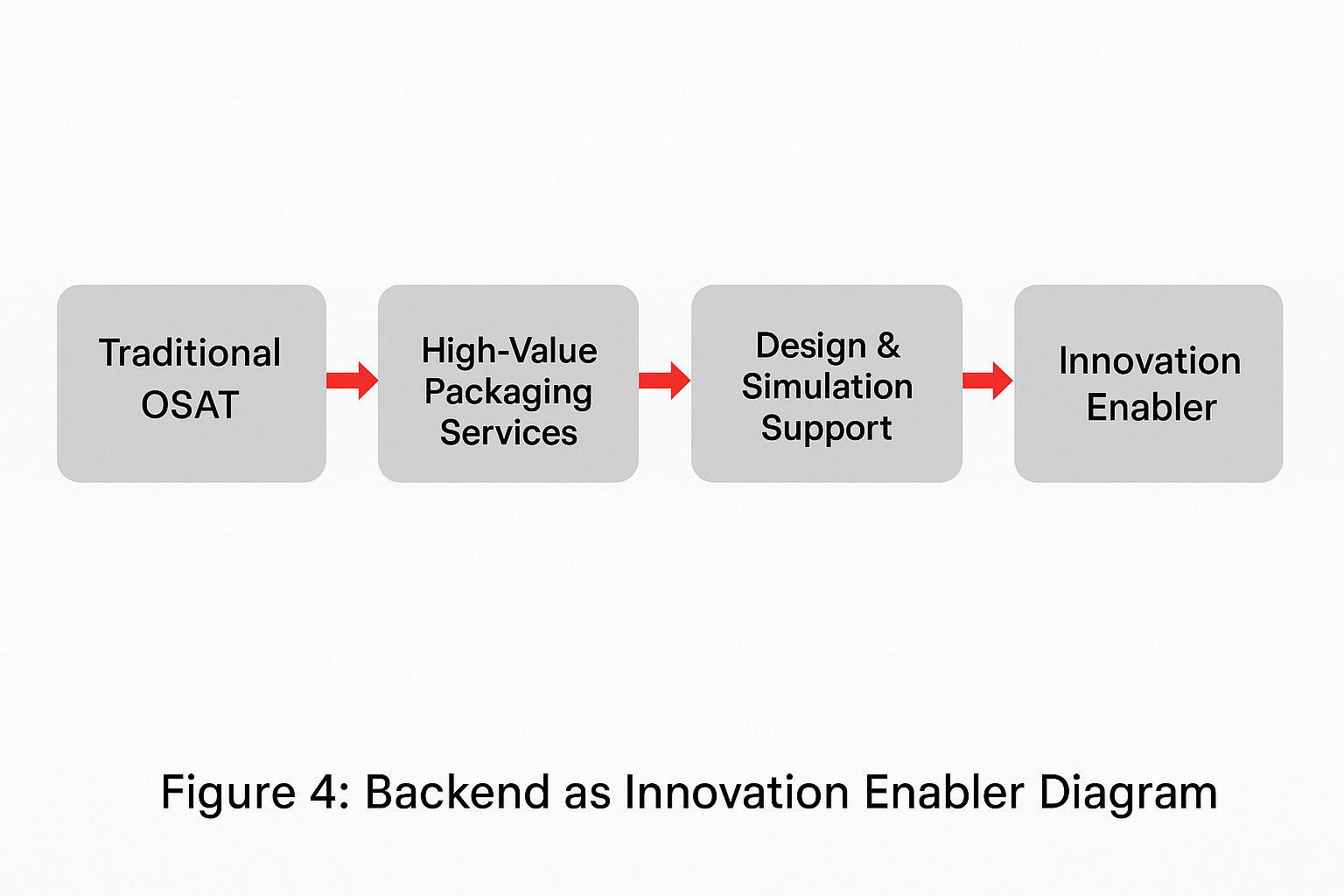
This figure illustrates the four-stage transformation of OSATs from traditional vendors to innovation enablers:
Stage
Name
Description
1️⃣
Traditional OSAT
Standard packaging and test services, focused on low cost and high volume
2️⃣
High-Value Packaging Services
FOWLP, SiP, 2.5D/3D offerings with partial design collaboration
3️⃣
Design & Simulation Support
Establishing co-design workflows and tools with IC/system teams
4️⃣
Innovation Enabler
Co-architecting heterogeneous systems with foundries, IDMs, fabless firms
📈 Each stage moves rightward, representing value chain advancement and capability upgrading.
Real-world examples:
ASE evolved from OSAT to FOCoS innovator collaborating with system companies
Amkor is co-developing high-reliability packaging for automotive applications
JCET built an SiP design center to offer integrated design services to fabless clients
Appendix: Key Terminology
Abbreviation
Full Term
Description
OSAT
Outsourced Semiconductor Assembly and Test
3rd-party packaging & testing vendors
FOWLP
Fan-Out Wafer-Level Packaging
Advanced packaging with rerouted I/O pads
TSV
Through-Silicon Via
Vertical interconnect for 3D IC stacking
RDL
Redistribution Layer
Reroutes die I/Os for external connection
CoWoS
Chip-on-Wafer-on-Substrate
TSMC's 2.5D packaging solution
SiP
System-in-Package
Integration of multiple chips in one module
FOCoS
Fan-Out Chip-on-Substrate
ASE's proprietary fan-out packaging solution