

There is a globe in my office that nobody buys for the children anymore. Plastic, probably-illegal-by-now-paint, mounted on a tilted brass spindle. I look at it sometimes between meetings. The first thing the eye does is sort the world into seven green slabs. Asia. Africa. The Americas. Europe. Oceania. Antarctica. The blue is just the background.
It takes a while to notice that the blue contains an enormous amount of land.
Sum the area of every island in the Natural Earth catalogue and you get 1.75 million square kilometres — already bigger than Iran, comparable to Mongolia. But Natural Earth, like every database, is selective: it codes Greenland, Borneo, New Guinea, Madagascar, and Honshu as “land masses,” not “islands,” and drops them from the cut. Add those back, plus the Indonesian and Philippine archipelagos as a whole, and the geographer’s standard accounting puts the global island total at roughly 10 million square kilometres — bigger than Europe (10.2M) by a hair, bigger than Australia (7.7M) by a comfortable margin. Smaller than Antarctica, but only because Antarctica is enormous.
If you laid every island next to every other island, you would have a continent. We have not given this continent a name. We do not invite it to summits. It does not get a Wikipedia infobox. It is the geographical equivalent of those people who hold the company together but never end up on the org chart.
Stacking the seven continents next to “All islands combined” gives the chart below. The aggregated island bar is in rose. It sits between Europe and Antarctica in size, larger than Australia, smaller than Asia, comfortably mid-table.
Why don’t we treat this as a continent? The answer is editorial. A continent is a story we tell about contiguity. Asia is one story because you can walk from Vladivostok to Lisbon. Africa is one story because the Sahara doesn’t actually break the rock. Europe is one story because someone in 18th-century Vienna decided it was. Islands fail this test by definition: they are scattered, ungovernable as a unit, useless to a 19th-century geographer trying to teach a class.
The eighth continent has no shared currency, no flag, no Eurovision. It also produces about 7% of global GDP, hosts the bulk of the world’s most ecologically distinct biota, and contains entire languages and legal traditions. It is, to put it gently, under-aggregated.
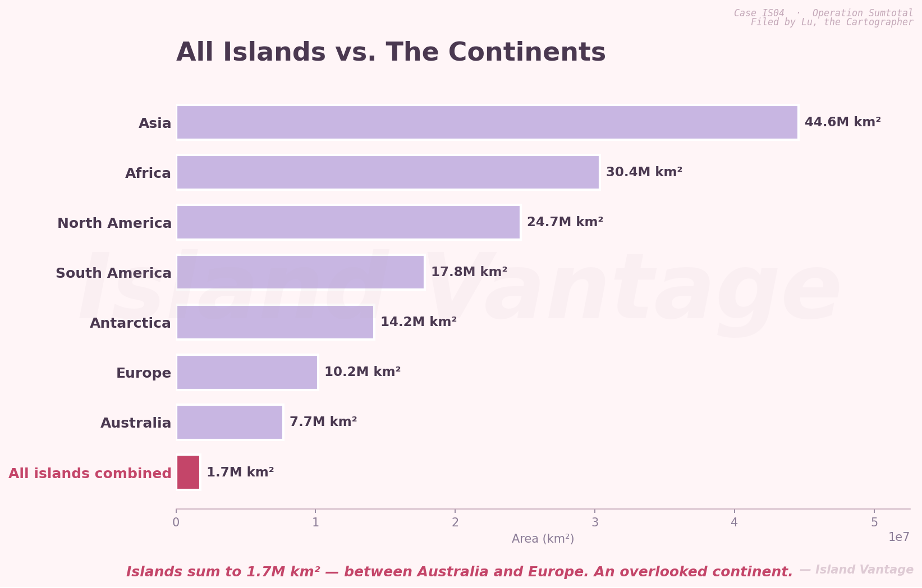
Figure 1 — All islands combined sit between Australia and Europe in area. The eighth continent, unmarketed.
There is a political lesson here, hidden in the bar chart. Aggregations are not just statistical conveniences; they are how political reality gets built. The European Union exists because somebody decided to add Belgium to Germany to Italy and treat the result as one thing. ASEAN exists because somebody did the same with Singapore plus Vietnam plus the Philippines. The aggregation came first; the policy came after.
Islands have nobody to do their addition. Each one negotiates its own trade deals, runs its own (often very limited) defence ministry, and gets ignored at climate summits because the largest single delegation has fewer constituents than a Manhattan zip code. There are economists who argue the developing-island world is the worst-served polity on Earth precisely because it never got an aggregator. They are probably right.
There is no eighth continent on the globe in my office. There is no eighth continent on any globe. The land that would make one is there. Somebody just hasn’t drawn the line.
— C.Y. Lu · Island Vantage · IS04