

Imagine a USGS technician sitting in front of a 30-cm-resolution satellite image of the Stockholm archipelago. She has been told to compile the official Global Islands database. The image shows what looks like an ink-spilled coastline: tens of thousands of dots, each potentially an island. She has a budget. She has a deadline. She has a coffee.
Her first question — the one she will ask quietly, in the privacy of a methods document footnote — is: what is the smallest thing I have to count?
A 1 m² rock and a 590,000 km² Madagascar are both, technically, islands.
Geographers have agreed for centuries that an island is “a piece of land surrounded by water.” They have not agreed on how big the piece has to be. The IHO definition is a vague “above water at high tide.” UNCLOS Article 121 adds that legal islands must “sustain human habitation or economic life of their own” — a clause whose interpretation has been litigated for forty years.
In practice, three thresholds dominate the field. Cartographers use 1 km² because anything smaller becomes a pixel on a 1:10M map. The USGS Global Islands Explorer uses 1 hectare (0.01 km²), because that’s the resolution at which their satellite imagery becomes useful. OpenStreetMap uses *whoever-bothered-to-tag-it* — sub-1m² rocks included.
Plotting the area distribution of every Natural Earth island on a log scale stretches across eight orders of magnitude. From sub-1-km² rocks to mainland-fragment giants near 700,000 km², the distribution looks like the Manhattan skyline reflected in disturbed water — a long left tail, a steep right rise, and three vertical lines marking the standard thresholds. (Natural Earth’s catalogue is itself selective: Greenland, Borneo, and similar continental-scale islands are coded as land masses rather than islands, so even this 2,805-entry dataset undercounts the largest end.)
Notice how every threshold sits inside the bulk of the distribution, not at its edges. This is not coincidence. Thresholds are drawn where they cause the *most useful* truncation for whoever is drawing them. Move the line by half an order of magnitude and you change the global count by an order of magnitude. The threshold is the variable; the world is constant.
You can see the same logic in any official statistic. The threshold for “small business” in the United States is 500 employees. In the European Union it’s 250. In Japan it’s 100. Same firms, same ledgers — three different worlds. A US “small” business would be a French *moyenne* and a Japanese outright large. Nobody is wrong, but nobody is talking about the same thing.
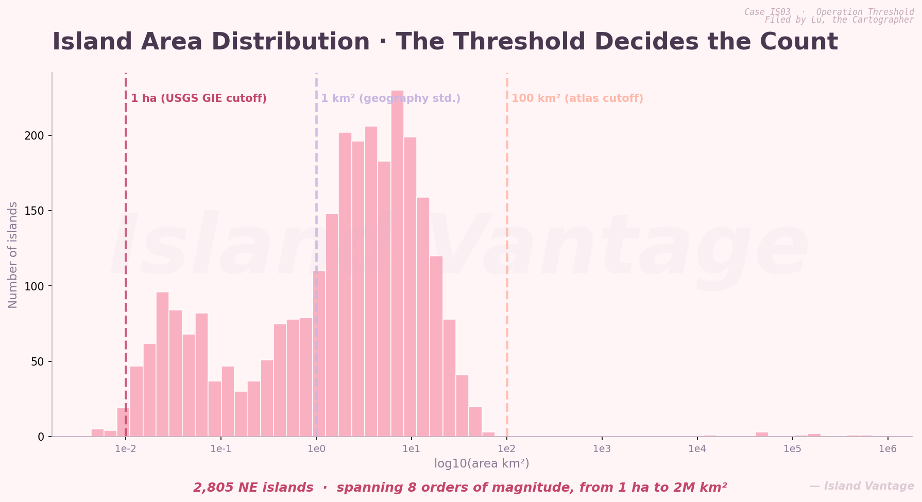
Figure 1 — Distribution of 2,805 island areas in Natural Earth, log scale. Three threshold lines: 1 ha (USGS), 1 km² (geography), 100 km² (atlas). Move the line, change the count.If the histogram shows the distribution, the chart below shows the dial. Slide the threshold from 1 m² to 1 million km², and the count of qualifying islands collapses from 2,805 to single digits along a smooth curve. The three vertical anchors mark the standard cut-offs. Each is a defensible decision. None is the truth.
If the histogram shows the distribution, the chart below shows the dial. Slide the threshold from 1 m² to 1 million km², and the count of qualifying islands collapses from 2,805 to single digits along a smooth curve. The three vertical anchors mark the standard cut-offs. Each is a defensible decision. None is the truth.
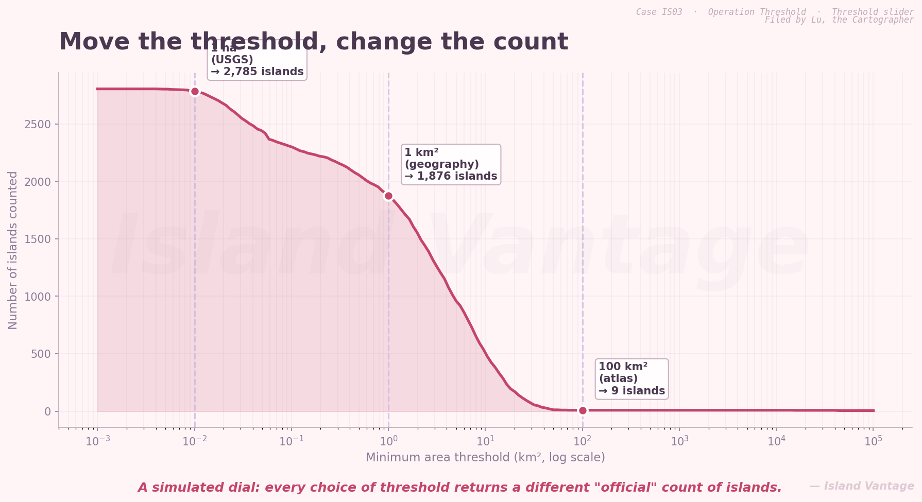
Figure 2 — A threshold simulator. Each tick on the curve is a candidate “official” count. The dial does the work the dataset cannot.
A threshold looks like a measurement decision. It is, almost always, a budget decision. Whoever sets the threshold has decided in advance which entities deserve attention and which fall below the line of bother. Census tracts, business sizes, poverty cutoffs, dietary deficiency limits, “low birthweight” definitions — every social statistic is gated by a number that someone, somewhere, picked because they had to pick something.
The economists’ word for this is operationalisation. Borrowed from psychology, it means “you cannot study X without first deciding which X counts as X.” Once the decision is made, it disappears into the methodology, and what comes out the other side looks like an objective number. It is not. It is a budget, in numerical disguise.
Every threshold is a quiet act of governance. Once you have drawn it, the world is sorted. The eligible from the ineligible, the islands from the rocks, the small business from the medium, the poor from the precarious. The number does the work that nobody wanted to argue about out loud.
— C.Y. Lu · Island Vantage · IS03