

C.Y. Lu | Island Vantage | English edition of a piece first published in Chinese on Oct 15, 2026
There is an island called Taiwan. On it is an industry that produced NT$5.3 trillion of output in 2024.
84.6% of that industry’s manufacturing comes from a single company.
In the third-quarter results that company published on October 15, 79% of revenue came from a single continent.
One island, one company, one continent. Every layer is a success, and every layer is more concentrated than the one before. This piece does something simple: it first concedes that this is a very good set of results, and then asks why the map those results draw keeps getting narrower.
The report card: hard to fault
Start with the numbers.
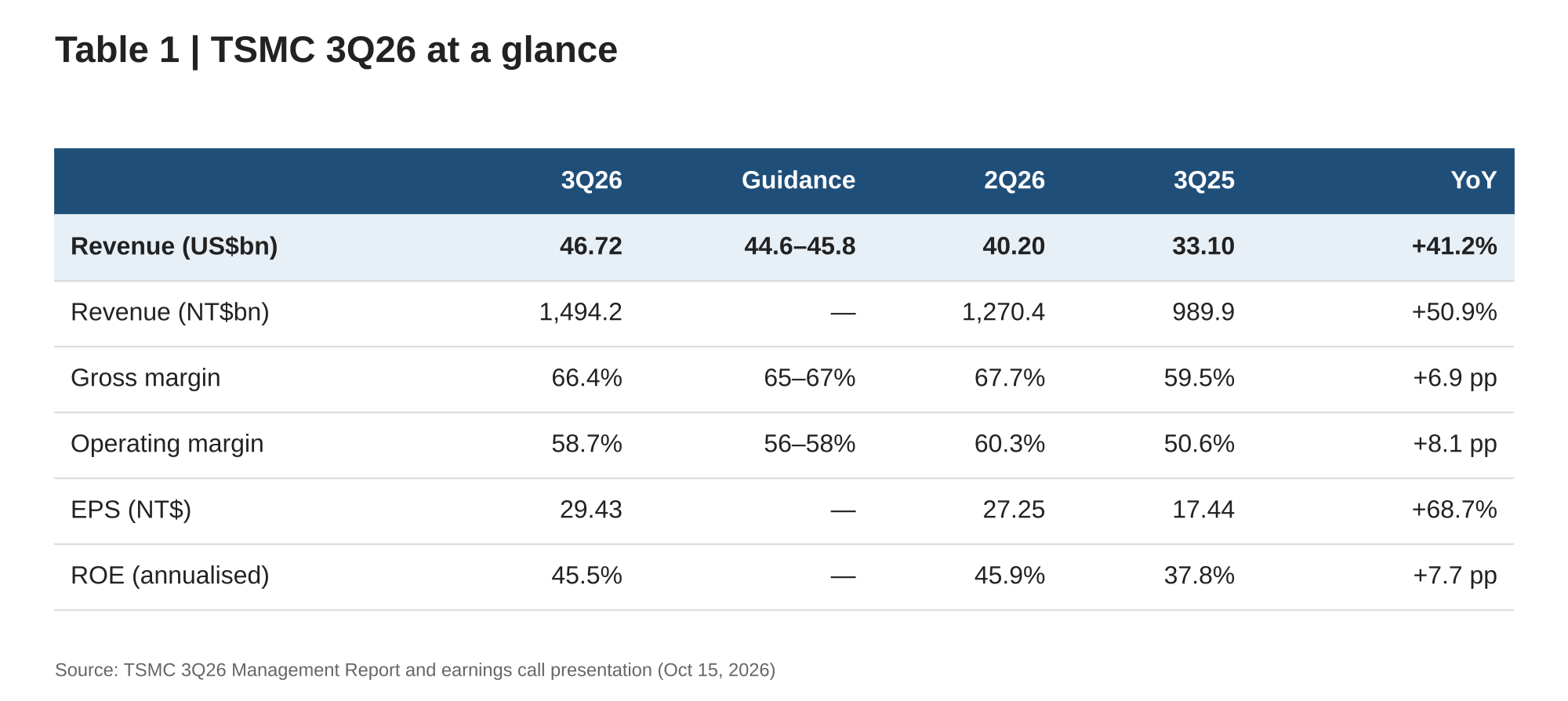
Guidance: revenue beat the top of the range, and operating margin came in above the guided band.
2nm: N2 has just entered volume production and yields are still ramping, which dilutes margins. Gross margin still landed at 66.4%.
Fourth quarter: guidance of US$52.3–54.3bn, implying roughly 44% US-dollar revenue growth for the full year.
A company that is already the world’s largest foundry is still growing 40% a year. Finding fault with that takes some nerve.
One number deserves a second look, though. Wafer shipments were only 9.6% higher than a year ago, while revenue was 50.9% higher. Average revenue per wafer rose from about NT$242,000 to NT$334,000, close to 40% more.
Picture the only coffee shop next to a train station. The queue is 10% longer, yet the owner takes in 50% more. Nobody leaves the queue, because the next shop is several stops away. When there is no substitute, price is set by what the customer can bear, not by cost.
How much of that 40% is price, and how much is the mix shifting toward 2nm and 3nm, the company does not disclose, and I cannot separate them. Nor does all the scarcity belong to the coffee shop: only ASML sells EUV scanners, and the landlord is raising the rent too.
But a financial report tells us not only how much was earned. It also tells us where the money came from.
A revenue map that keeps narrowing
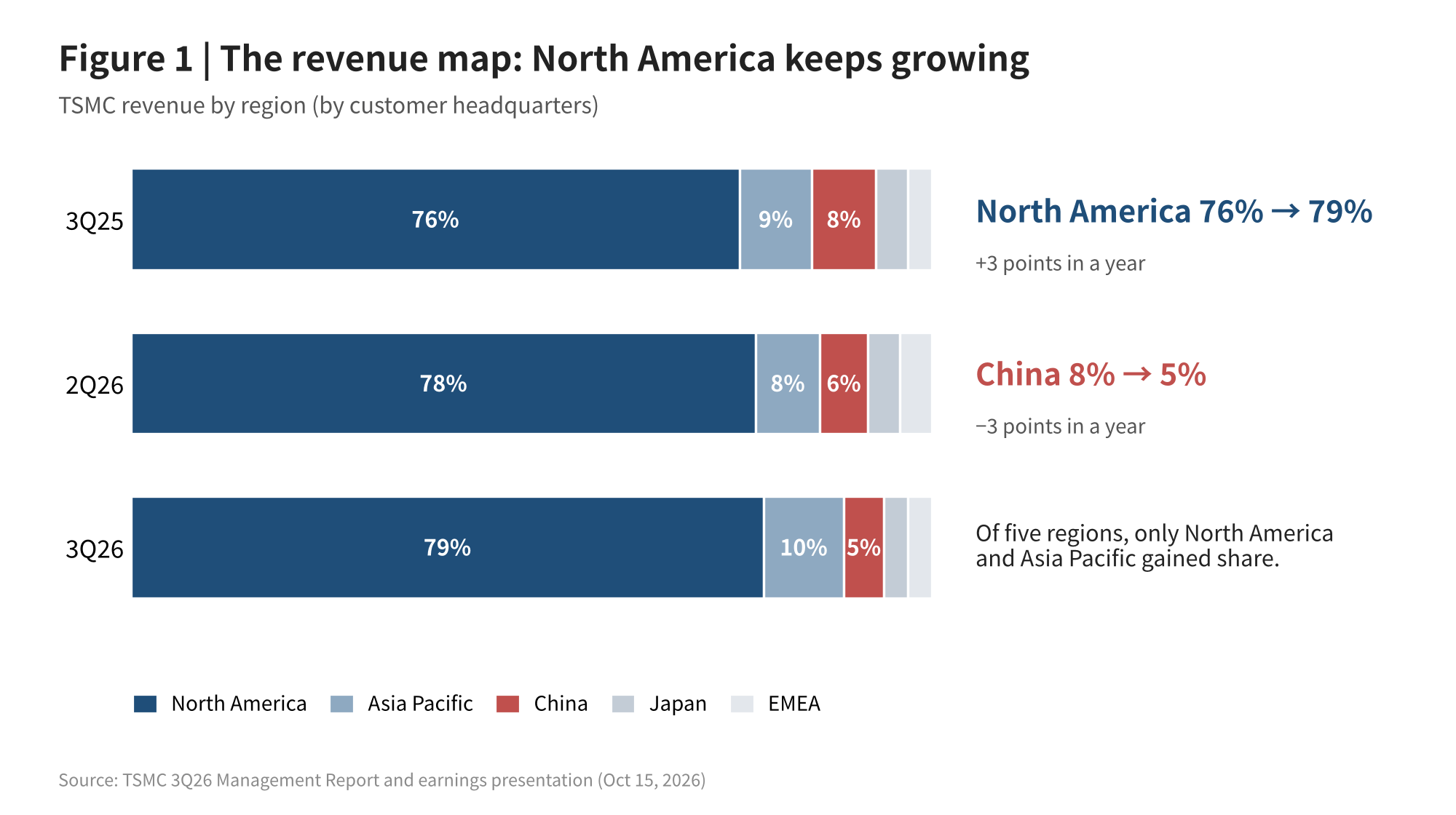
TSMC reports revenue by the location of each customer’s headquarters. Over these three quarters, North America rose from 76% to 79%, and China fell from 8% to 5%.
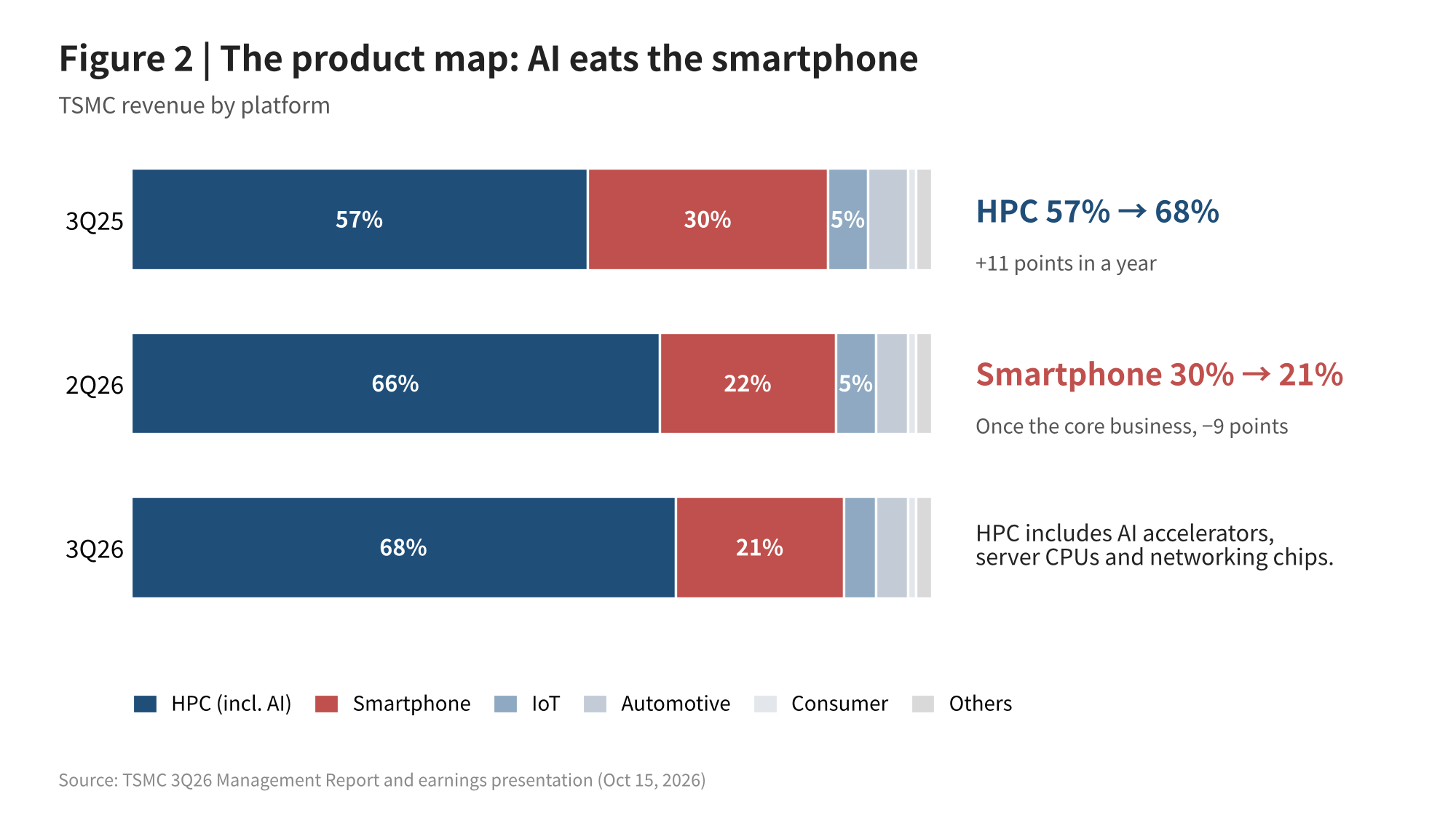
The product mix tells the same story. HPC (high-performance computing, mostly AI accelerators and server chips) rose from 57% to 68%. Smartphones fell from 30% to 21%; a decade ago they were TSMC’s core business.
Shares can mislead. If a class’s average height goes up, it does not mean the shorter students shrank; maybe a few basketball players transferred in. When a pie gets bigger, a falling share does not mean a slice got smaller. So I multiplied the shares back into revenue to get amounts:
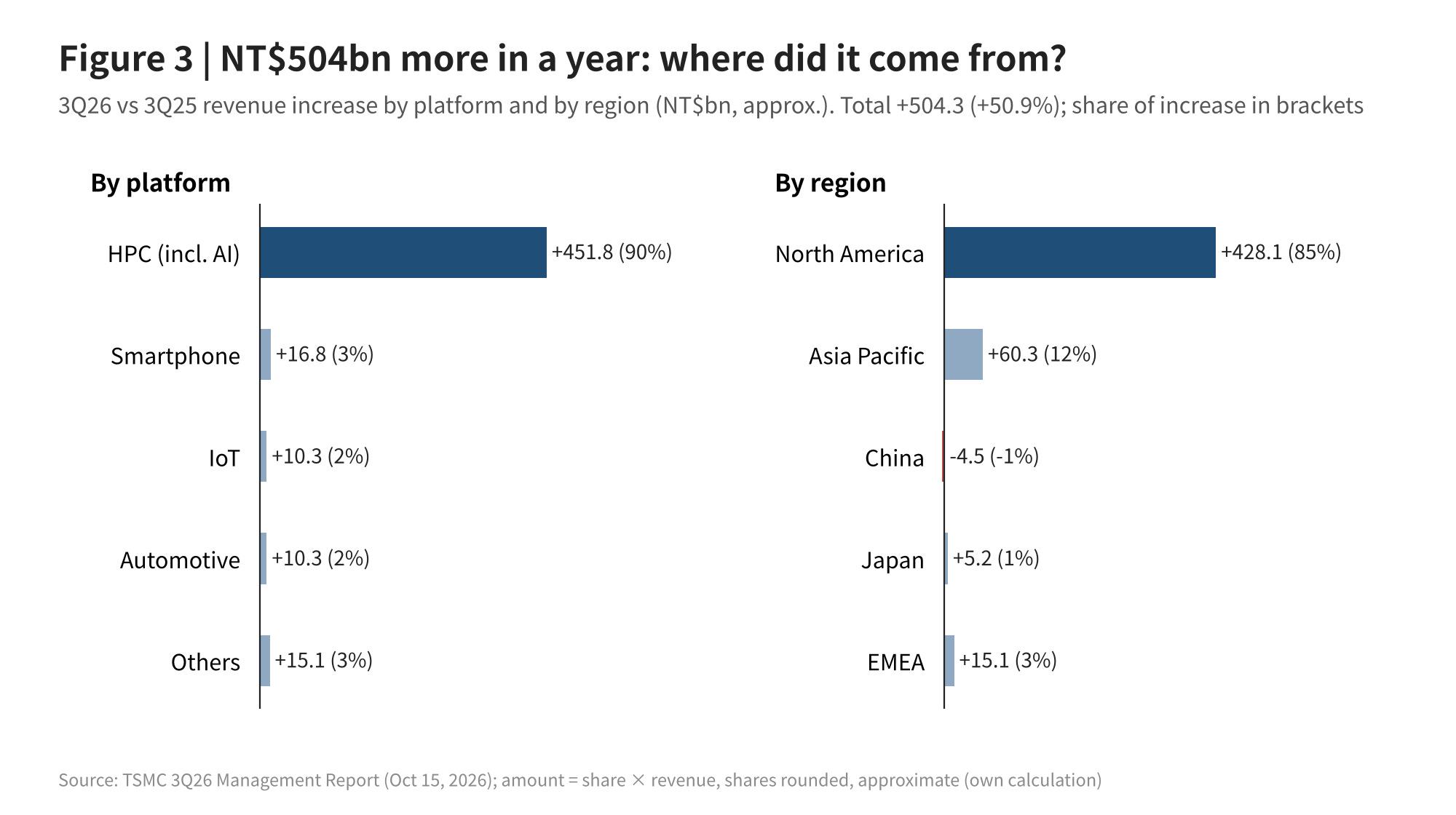
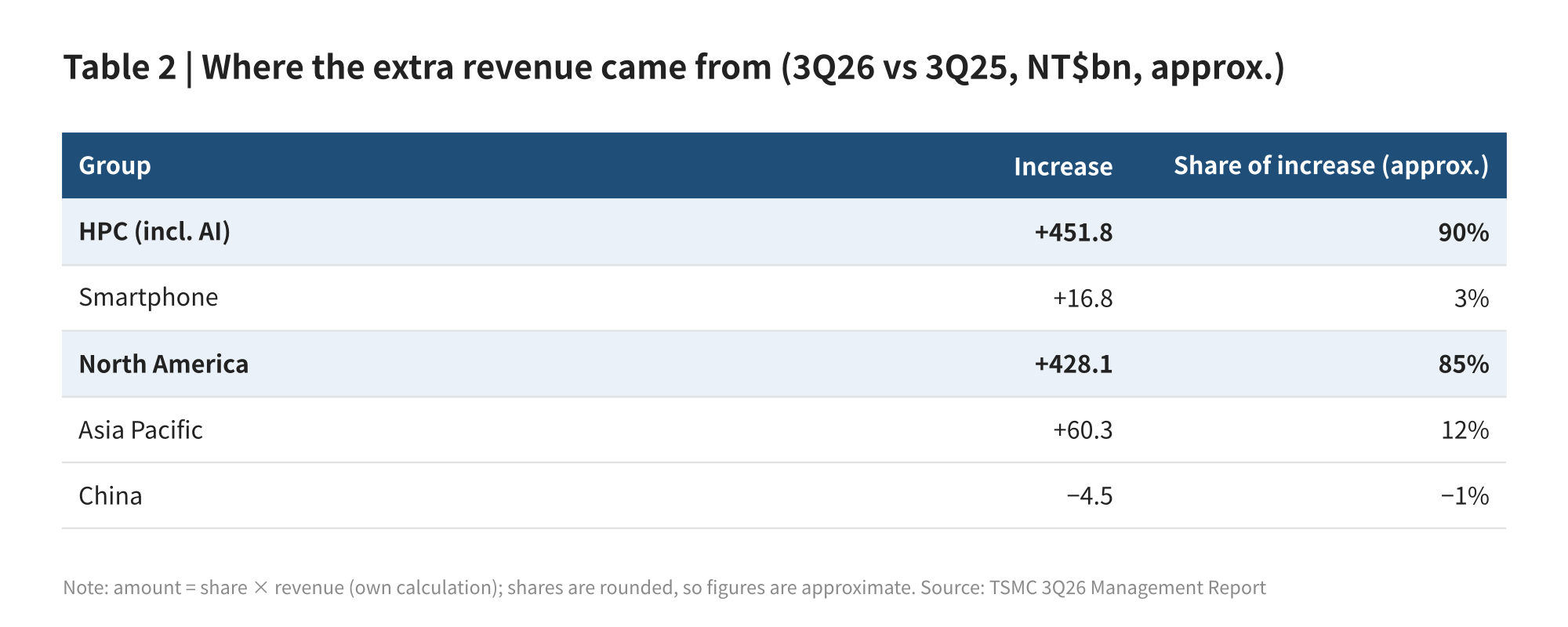
The table is blunter than the shares:
Source of growth: of the extra NT$504bn in a year, roughly 90% came from AI and roughly 85% from North America.
China: total revenue grew by half, yet China’s amount did not keep up; on paper it fell by about NT$4.5bn. Shares are only published as whole numbers, though, and once rounding is allowed for, China’s change lies somewhere between about −NT$16.9bn and +NT$7.9bn. What is certain is that it did not keep pace. Whether it is actually shrinking needs another quarter or two.
Smartphones: yesterday’s core business added only NT$16.8bn, almost invisible in the AI wave.
The growth is real. But it is coming down a single road.
Zooming out: one supply chain, two fates
Look only at TSMC and it is easy to believe the whole semiconductor industry is having a great time. I previously compiled the 2025 annual reports of 36 global semiconductor supply-chain companies, from equipment, foundry, memory, IC design and packaging through systems hardware, cloud platforms and cars. Lined up by operating margin, they look like this:
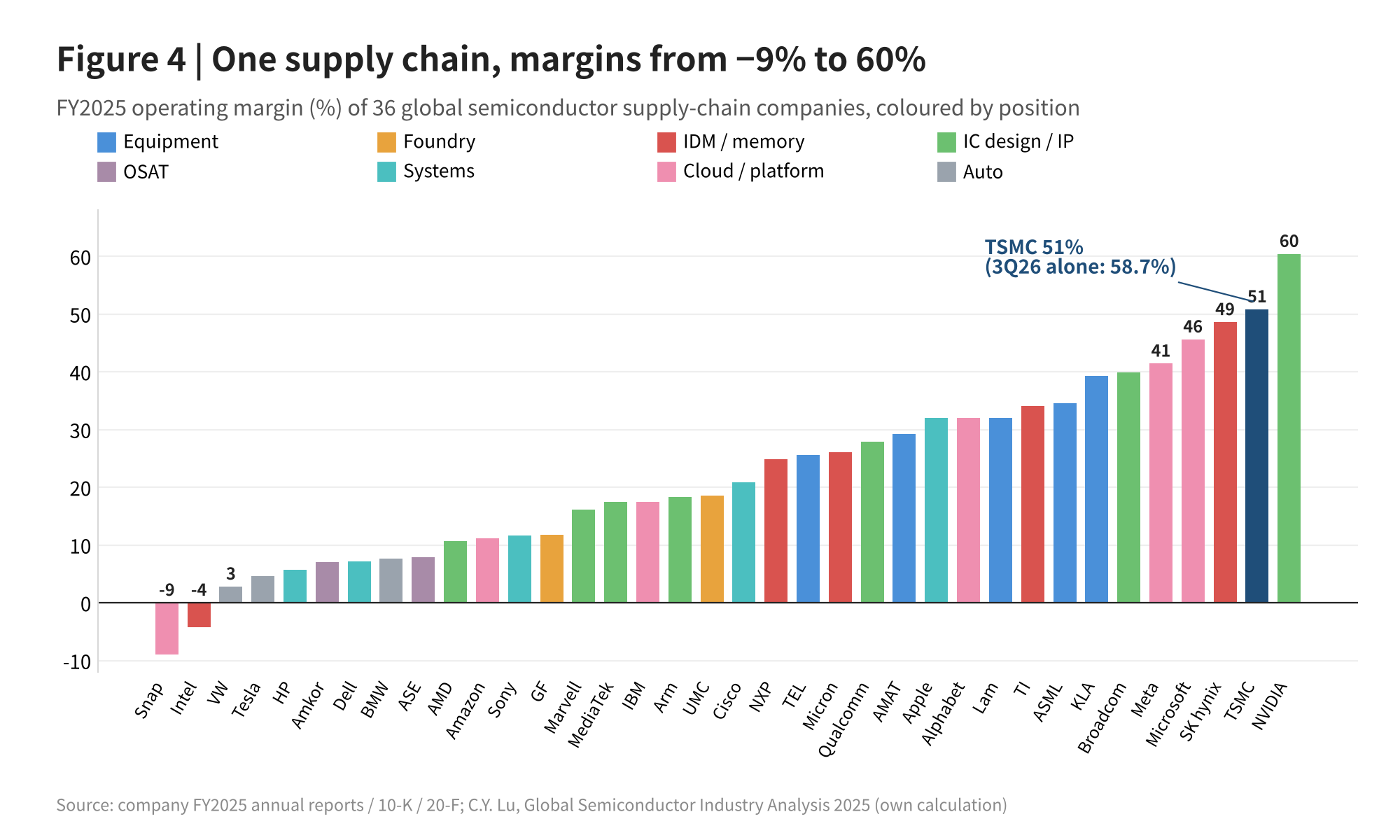
Top: NVIDIA 60%, TSMC 51%, SK hynix 49%.
Bottom: Intel −4%, Volkswagen 3%, Snap −9%.
Within one supply chain, operating margins differ by almost 70 percentage points. AI has pushed money from the cloud down through chips, foundries and memory; cars and mature-node manufacturing stayed where they were.
So who, in the end, is paying for TSMC’s 79% North American revenue?
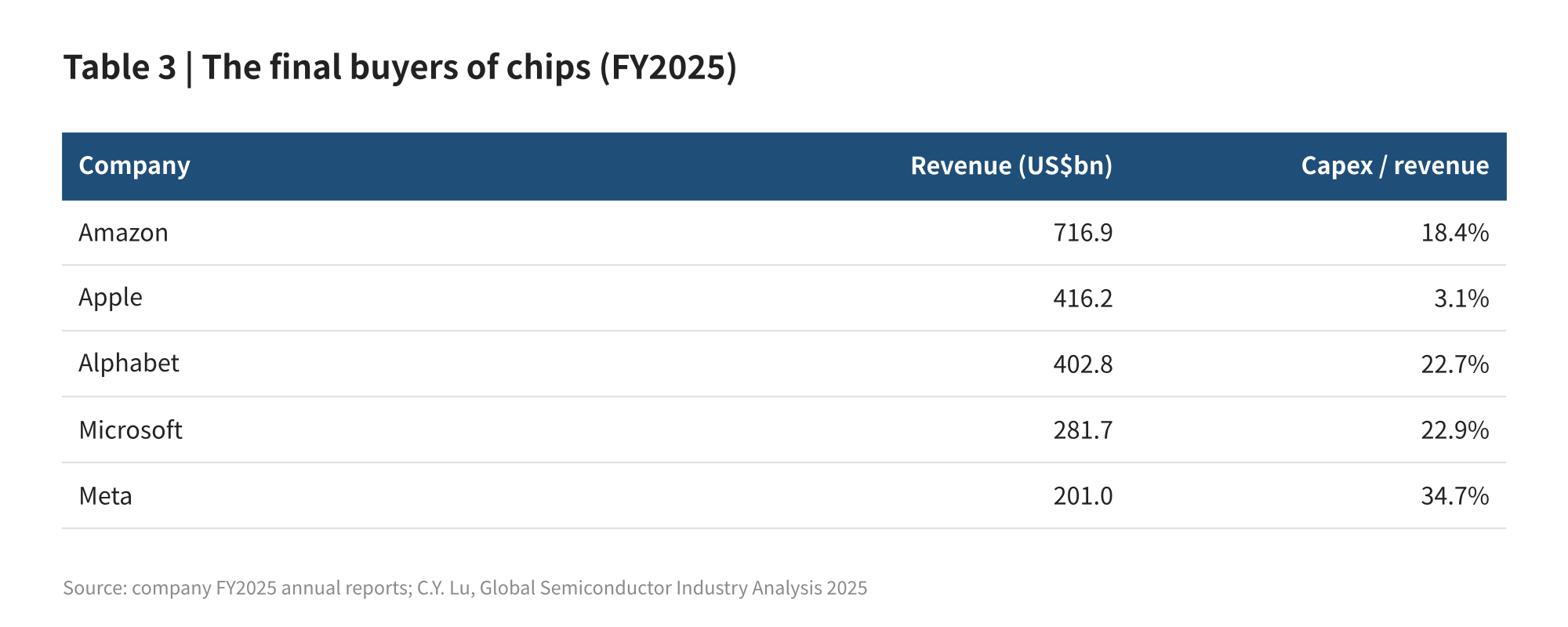
Among the 36 companies, none of the five largest by revenue is a semiconductor company. They are the final buyers of chips, and for several of the cloud providers capital spending has reached 20–35% of revenue. Their balance sheets look more and more like foundries’.
So “North America 79%” is not an abstract continent. It is a handful of companies building data centres at a furious pace. Geographic concentration is, underneath, buyer concentration.
Back to the island: the bill, the container, the socket
Now back to Taiwan. In a separate Taiwan Semiconductor Industry Report, I summarised Taiwan’s position in the world:
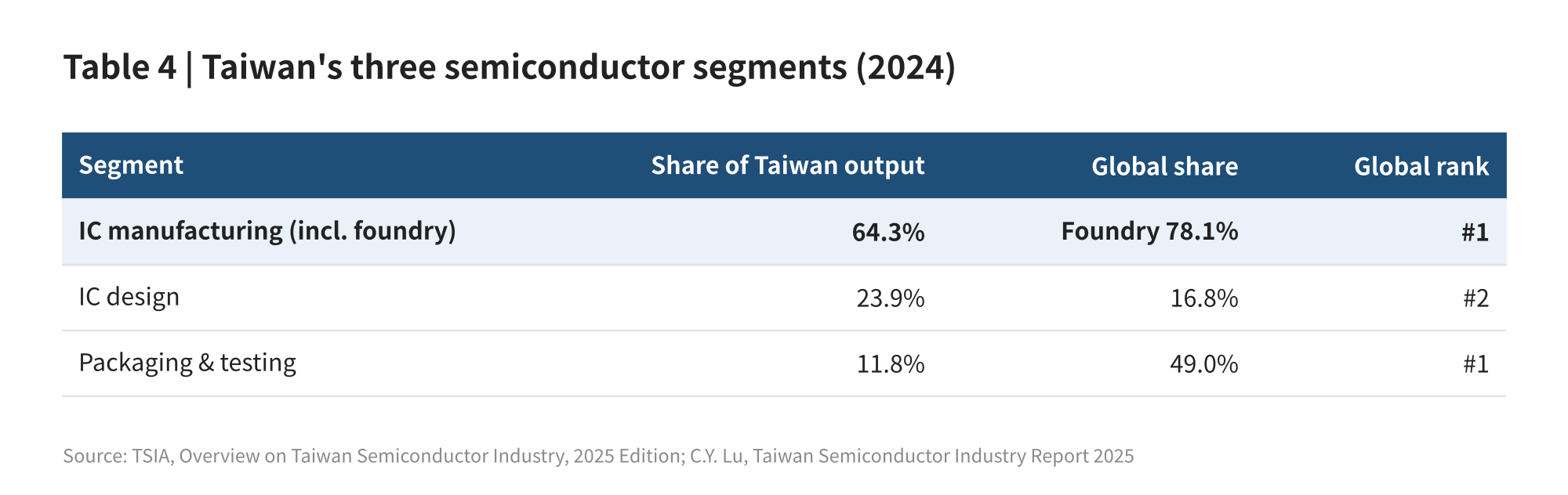
One number from that report becomes interesting next to TSMC’s results: in 2024, 51.6% of Taiwan’s IC exports went to China (including Hong Kong).
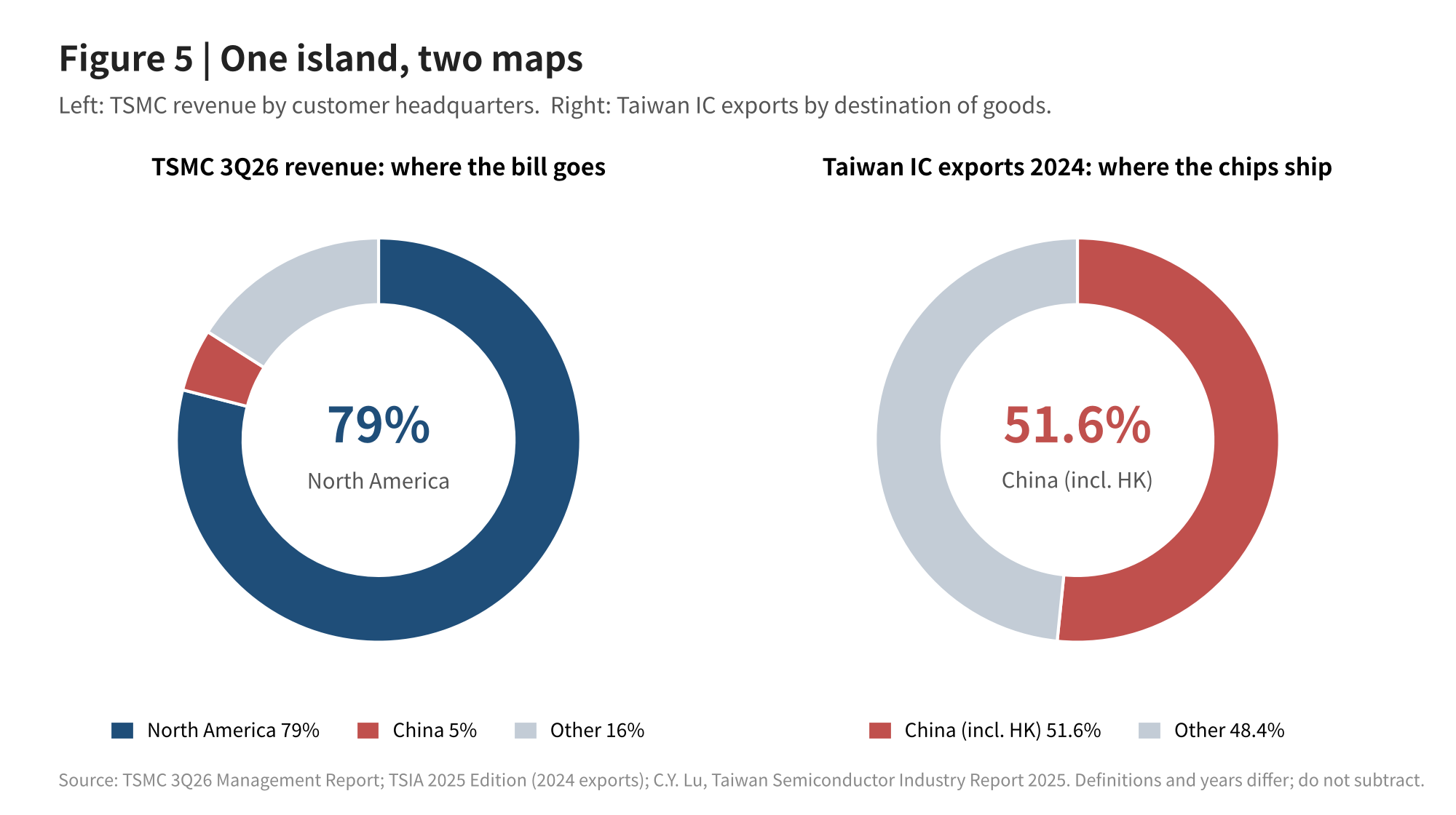
On the left is TSMC’s revenue: North America 79%, China 5%. On the right are Taiwan’s IC exports: more than half to China. Neither chart is wrong; they answer different questions. A chip actually leaves a record in three places. The bill goes to the customer who placed the order. The container goes to the assembly plant. And finally the chip goes into some socket: a phone, a laptop, or an accelerator card in a data centre.
The billing address: TSMC groups revenue by customer headquarters, which asks “who pays?” Export controls keep Chinese customers away from the leading nodes, while AI makes US customers buy more. Both forces push the bill toward North America.
The shipping address: export statistics follow the destination of goods, which asks “where is it assembled?” A chip is not a finished product; it has to be packaged, mounted on a board and built into a device, and a large share of the world’s consumer-electronics assembly capacity is still in China.
The socket address: where a chip finally works depends on the product. AI chips mostly end up in North American cloud data centres; phones and PCs assembled in China are sold all over the world, with China only one of many markets. No public dataset answers this one directly.
Another set of numbers makes this clearer. In 2025, exports to the US made up 30.9% of Taiwan’s total exports, overtaking China and Hong Kong (26.6%) for the first time in 26 years, driven mainly by servers and other ICT products. Yet half of IC exports still go to China. It looks contradictory, but it is the same rule: chips go to China, servers go to the US. The only difference is whether the thing leaves the island as a component or as a finished product.
So the island carries two kinds of geopolitical risk:
Billing risk: a handful of North American buyers brake at the same time. This is what the 79% is about.
Route risk: the assembly chain is cut, and finished chips cannot be built into products. Smartphones are still 21% of TSMC’s revenue; this is what the 51.6% is a reminder of.
The three addresses also map onto three regimes: financial reports follow the bill, tariffs follow the container, export controls follow the socket. The same chip has a different “nationality” under each. Whoever wants to argue that “Taiwan can’t do without China”, or that “Taiwan has already pivoted to the US”, can find a number to support it. Before reading a number, ask how it was counted.
Note: the three sets of numbers cover different years and scopes (3Q26 revenue, 2024 IC exports, 2025 total exports). They can be set side by side, but not subtracted from one another.
An economist’s view: mutual hold-up
Economics has a concept called hold-up. When one party makes an investment that is specific to a particular trading partner, that investment is worth little elsewhere, and the partner gains bargaining power.
Applied to TSMC, the hold-up runs both ways.
TSMC’s side: capital expenditure of US$40.6bn in the first three quarters. Much of the 2nm and advanced-packaging capacity is being built to fit the product cadence of a few customers. That capacity is hard to redeploy to anyone else.
The customers’ side: there is, for now, essentially one foundry that can both mass-produce 2nm and do advanced packaging at scale. A chip a customer has designed has no second place to be ordered.
The result is that neither side can leave the other. That makes the relationship stable, because nobody wants to leave first; but it also ties both to the same cycle.
The contrast with the smartphone era makes this clearer:
Smartphone era: customers were spread across several brands. If one cut orders, another might be chasing them, and the swings offset each other.
AI era: demand is concentrated in a few cloud and GPU companies whose capex plans move closely together. They add capacity together in good times, and when the cycle turns, they may brake together.
Concentration itself is not a mistake. It is a by-product of success. The problem is that it swaps risks that used to be spread out for risks that move in sync.
The island’s insurance is on the balance sheet
TSMC knows this, of course. A few numbers in this report read like insurance policies:
Net cash of NT$2.99 trillion: up almost NT$500bn in a single quarter.
Quarterly free cash flow of NT$476.6bn: after NT$443.2bn of capital expenditure.
Inventory days down from 87 to 82: shipments are moving faster; there is no stockpiling.
NT$198.7bn of other investing inflows: mainly investment tax credits from the US Treasury.
The last item deserves a closer look. The US is no longer only where TSMC’s biggest customers are; it is becoming a source of cash as well. One more link has been added to the chain of dependence. Subsidies always work the same way: the money arrives first, the conditions follow. Build a fab on someone else’s land, and part of your optionality is handed over.
The dividend follows the same logic. A quarterly cash dividend of NT$7 against second-quarter EPS of NT$27.25 is a payout ratio of about a quarter. Chunghwa Telecom, another heavyweight of the Taiwan market, pays out about 104%. Chunghwa does not have many fabs to build, so it pays out everything. TSMC does, and it is not sure where it will be asked to build the next one, so it keeps the cash.
A company holding 40% of its assets in cash and securities might look a little conservative by textbook standards. For a company on a small island whose customers are concentrated on one continent, it may be exactly right. But is the cash there for opportunity, or for risk? On a balance sheet, the two look identical.
Specialisation is the edge, and the exposure
An island’s advantage has always been specialisation: not doing everything, but doing one thing so well that nobody can catch up. TSMC is the extreme case of that kind of specialisation.
The other side of specialisation is concentration. This quarter, 79% of revenue came from North America, 68% from AI, and 90% of the growth came down one road.
Three things to watch next:
Whether HPC’s share keeps rising in the fourth quarter. If it passes 70%, concentration turns from a trend into a structure.
Whether China revenue is actually shrinking in amount. Look at amounts, and include the rounding error.
The cloud companies’ capex plans for 2027. That is TSMC’s real guidance.
One island, selling to one continent. The business is going very well right now, well enough that I want to leave one question open: if North America reaches 90% one day, should we be worried about TSMC, or about the five companies behind that 90%?
I don’t have the answer. But when the next report comes out, the first thing to check will not be whether it beat guidance. It will be how much narrower this map has become, and how many more data centres those few companies plan to build next year.
Sources
TSMC, 3Q26 Management Report, 3Q26 earnings call presentation, and 3Q26 consolidated financial statements (Oct 15, 2026)
Taiwan Semiconductor Industry Association (TSIA), Overview on Taiwan Semiconductor Industry, 2025 edition
Ministry of Finance, Taiwan, 2025 trade statistics (exports to the US 30.9%; to China and Hong Kong 26.6%)
C.Y. Lu, Global Semiconductor Industry Analysis 2025 (2025 annual reports of 36 companies)
C.Y. Lu, Taiwan Semiconductor Industry Report 2025
This is industry analysis and does not constitute investment advice. Originally published in Traditional Chinese as 〈產業觀點:一座小島,賣給一個大陸〉.